
Filed under: Vietnam
In southern Vietnam, cải lương ( reformed theater) is the popular form of opera. In the early 1900s the musical theater underwent a modernization, updating themes and musical styles. Soon thereafter vọng cổ emerged as part of the musical structure of cải lương, as the popular song Dạ cổ hoài lang became a centerpiece of the cải lương performance. An unusual musical process began to take place. Over time, the phrases of the song were expanded with the musicians improvising throughout the elongated phrases, but always ending on the pitch of the melody. The number of beats between melody notes kept doubling over the years allowing for longer and longer periods of improvising. The melody has been expanded and filled in with improvising to such an extent that the original melody is basically unrecognizable, often not making it beyond the first three notes of the melody! If this sounds confusing, that’s because it is!
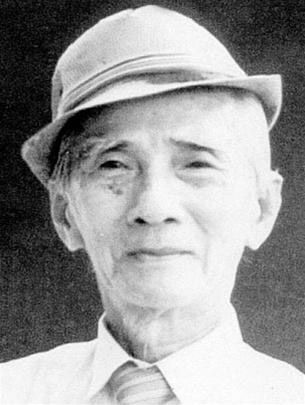
Viễn Châu, lyricist and guitarist
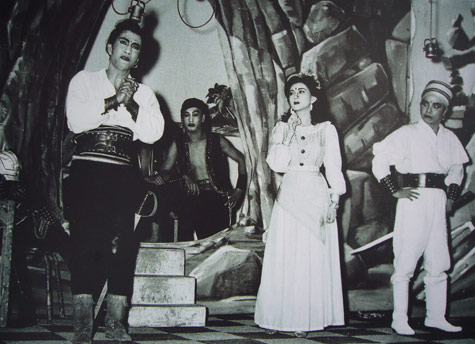
Út Trà Ôn
Please accept my humble apologies for the condition of this record…it’s scratchy, but better than nothing!

Filed under: Vietnam
Vietnam has a very rich diversity of musical styles, due in part to it’s geography, ethnic groups and the fact that it blends Chinese, as well as Southeast Asian musical influences.
Here’s an example of ca hue from the same Victor series as our last posting. Ca hue is a type of composed music that dates back to the 1500’s when Hue, in central Vietnam, became a cultural center independent of Hanoi in the north. The singer plays a wooden clapper and the ensemble usually consists of the “five excellent instruments”; dan tranh (zither), dan nhi (2 string fiddle), dan nguyet (2 string lute), dan day (3 string lute) and ty ba (pear shaped lute), sometimes a flute replaces one of the lutes.
This song is called Tu Dai Canh and is one of the standard pieces of ca hue repertoire.
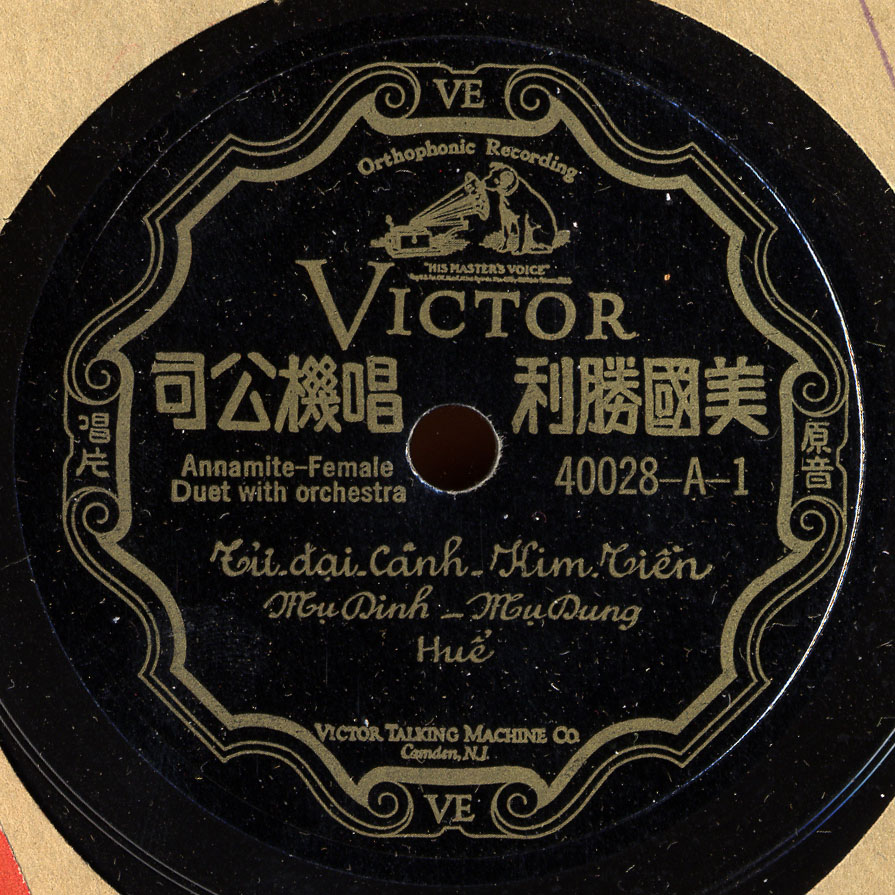
Thanks again to Terry Miller for label translation and musical info. Some information on ca hue came on from Phong Nguyen’s article on Vietnamese music in the indispensable Garland Handbook of Southeast Asian Music, edited by Terry Miller and Sean Williams.
Although Vietnamese music is highly influenced by Chinese (Vietnam was ruled by China for almost 1000 years!), the are many distinctive instruments, especially stringed lutes with raised frets. Here’s a few old postcards depicting Vietnamese musicians and some unique instruments, ca. 1900-10.
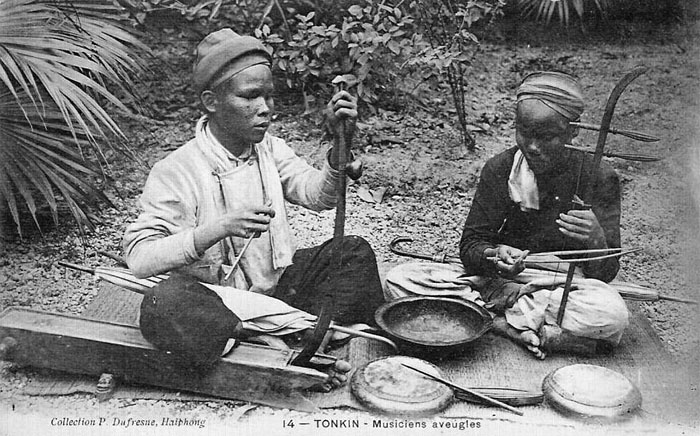
On the left, the single string Dan Bau. On the right is the two string fiddle called Dan Nhi.

Another uniquely Vietnamese instrument with raised frets, the Dan Day.
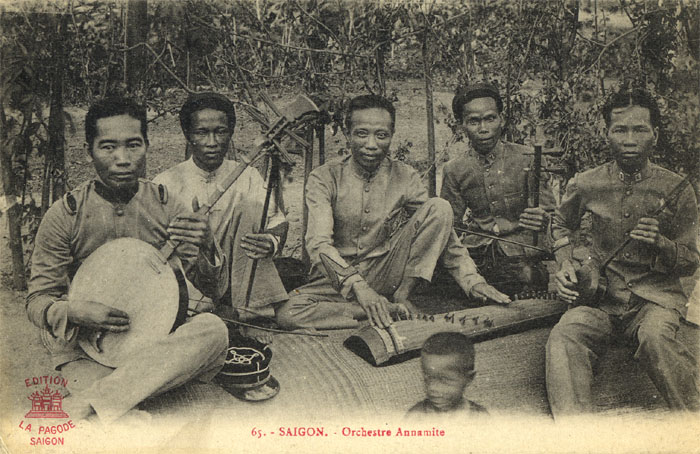
L to R; another raised fret instrument is the Dan Nguyet (in the south called Dan Kim), a bowed Dan Nhi, the Vietnamese zither called Dan Tranh, I can't quite make out the next fiddle, but I think it's a Dan Gao, and finally the Dan Tam, related to the Chinese sanxian.
Filed under: Vietnam
My apologies for the long delays between posts, I was sidetracked by some Greek music projects and summer vacation. So, without further delay, here is the first of a short series of records from Vietnam.
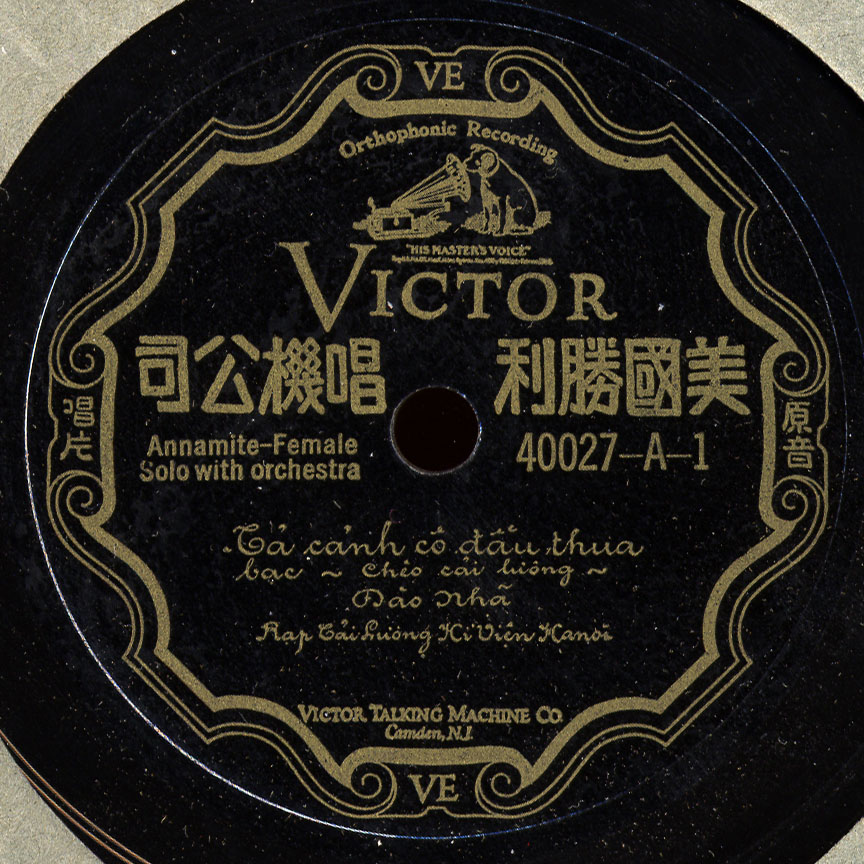
This record was recorded in 1927 for Victor’s 40000 series, a mysterious group of recordings from Indochina, as it was then called. I have yet to find any solid discographical information on this series aside from a mention of the above dialects in an old Victor catalog (thanks to Du Jun Min). This series is followed by the 42000 series of Chinese (mostly Cantonese) records.
I was fortunate to have Terry Miller translate and annotate a small group of records in this series. He writes:
This is a hat cheo theater song, Tả cảnh cô đầu thua bạc (describing a singer who lost her competition). The genre is cheo cai luong (reformed cheo theater), the singer is Dao (Ms.) Nha, and the place is rạp Cải Lương Hý Viên Hanoi (the Cai Luong Theater of Hanoi).
(Hat Cheo is an ancient form of vernacular theater from North Vietnam that reached it’s peak in the 19th century. It includes satire, songs, dances and skits.
Annamite refers to a region of central Vietnam then called Annam, but at the time was used to refer generally to all Vietnamese people. -Haji Maji)
Please have a look and listen at Excavated Shellac’s current post from Laos!
Filed under: Japan
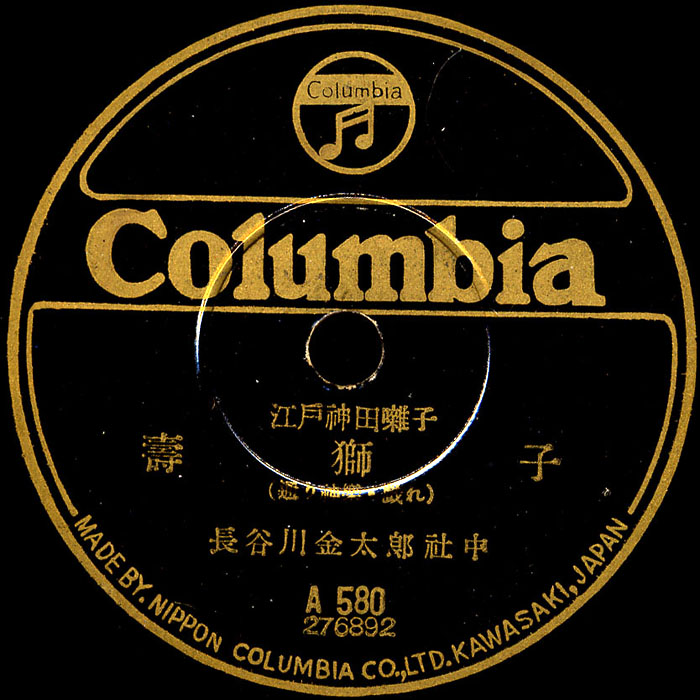
Here’s another great Japanese record on Columbia. This wild music is called Toori Kagura Tawamure, sacred music played at Shinto festivals for Kotobuki Jishi (Lion Dance). This particular piece is Edo Kanda Bayashi.
In and around Tokyo, there are many shrines which have seasonal festivals, mainly in autumn, at which hayashi music and folkloric dance-dramas are performed for the public. The Hayashi is generally called matsuri hayashi (festival hayashi). Kanda Bayashi is one of them, which is used in the Kanda district of downtown Tokyo. The ensemble usually consists of a flute, two flat barrel drums played with two sticks, a gong and a big drum.
Here’s some visuals for you:
Kanda Bayashi:
Lion Dance:
Thanks once again to Mary Mariko Ohno, director of the Kabuki Academy in Tacoma, Washington, for translation and other info…these Japanese posts couldn’t have been done without her help…thanks!
Filed under: Japan
Here’s one of my favorite shamisen records, and since spring is upon us I’ve decided to post both sides.
Tune in next week for one more Japanese record, after that we head down to Southeast Asia!
The first side is Ume nimo Haru (Plum Blossom in Spring), a well known hauta song that accompanies a dance of the same name. Hauta is a type of song popular in Edo (Tokyo) in the 19th century.
“In a light mood it describes various sights of the New Year and connects them to the feelings of a woman in the pleasure quarters waiting for her lover. Instead of seeing the person she is awaiting so anxiously, she sees all these other things instead.” from http://jtrad.columbia.jp
Sung by Fujimoto Fumikichi with shamisen by Koshizu Kin.
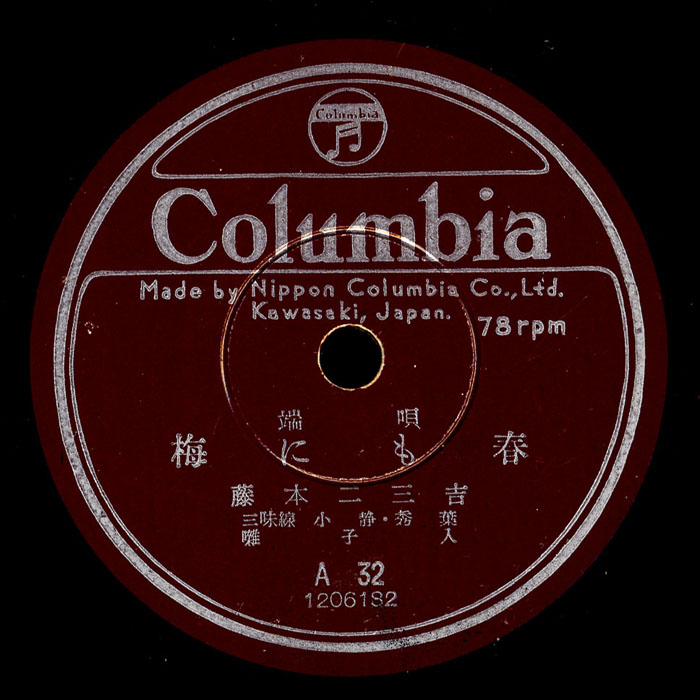
>Ume nimo Haru (Columbia A32 – 1206182)
The second side is Harusame (Spring Rain).
“This song describes a warbler in the spring rain perfumed by the fragrant plum blossoms. While being a poetic description of spring, it also carries a faintly erotic atmosphere.” Again, from http://jtrad.columbia.jp
Sung by Kanda Fukumaru.

>Harusame (Columbia A32- 2206185)
Another big thanks to Mary Mariko Ohno, director of the Kabuki Academy in Tacoma, Washington, for translation and other info…thanks Mary!
Filed under: Japan

I’m a big fan of the shamisen and it’s ancestor the Chinese sanxian. Maybe it’s because the banjo was one of my first instruments? The shamisen and it’s family are typically three string fretless banjos with snake, cat, dog or calf skin stretched across the body.
The Tsugaru style shamisen is currently in vogue, thanks to the Yoshida Brothers. Tsugaru style is usually fast, with virtuosic playing and it is uses a bigger, heavier instrument. Incidentally, Tsugaru has an interesting history, as told in comic strip form by California’s own shamisen monster, Kevin Kmetz.
But these sparser, slower styles are sometimes more interesting to me, this one in particular reminds me how bluesy a lot of Asian and southeast Asian music can sound…Chinese guqin, Vietnamese vọng cổ and Khmer mohori music are some other examples
The song is the well known Yasuki Bushi which is associated with the “fish scooping dance” (see Excavated Shellac for another example). Here it is sung by Murano Koichi with shamisen played by Tachibanaya Kin-nosuke.
The label also indicates that this is a ko-uta; short songs typically sung by geisha.
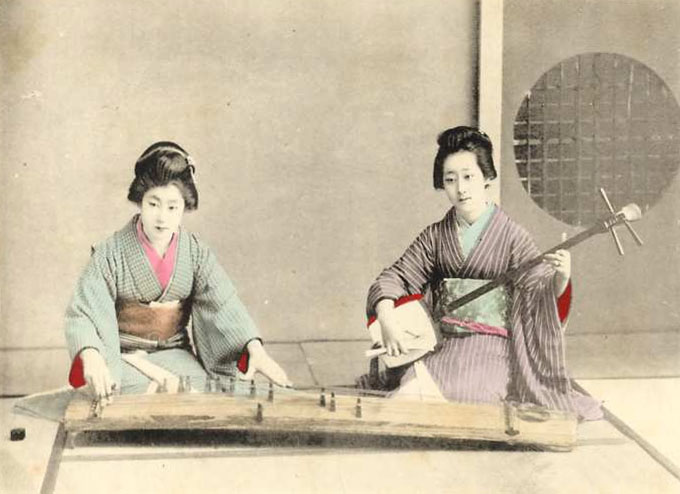
(special thanks to Mary Mariko Ohno, director of the Kabuki Academy in Tacoma, Washington and Linda Kako Caplan. Also, thanks Excavated Shellac’s JW for some work on the audio restoration…cheers!)
Filed under: Japan
In January we heard an example of the Chinese zither called guzheng, and now I’d like to present one of it’s descendants; the Japanese koto.

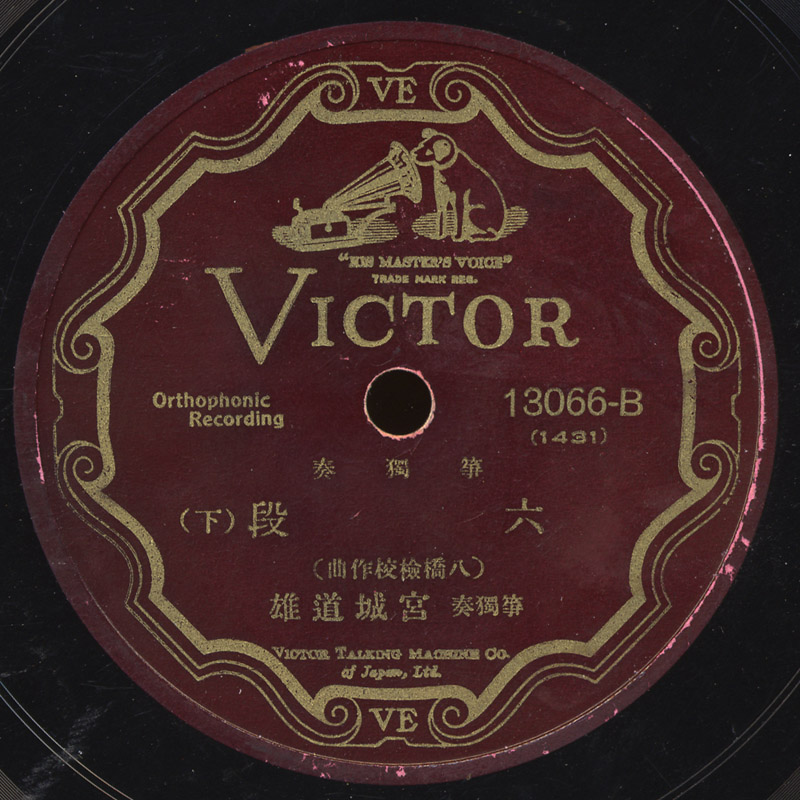
The koto came from China to Japan sometime between the 7th and 8th century and was used primarily in the gagaku ensemble, Japanese court music (see World Arbiter). Like the guzheng, the koto is a long zither with bridges and it went through many configurations over the centuries in terms of size, construction and number of strings. In the 17th century the gifted blind musician Yatsuhashi Kengyo (1614-1685) created a new style of solo playing and this record is one of his most famous pieces, Rokudan No Shirabe.
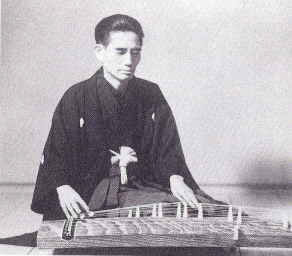
The Koto player featured on this recording is another famous blind musician, Michio Miyagi. He was something of a genius; teaching by age 13, creating new instruments such as the 80 string hachi-jyugern, making records, writing essays and exploring the music of the west. He published more than 500 compositions before he died in a train accident at the age of 62.
_______________________________________________
Here is the full piece, Rokudan No Shirabe, from sides A and B.

_______________________________________________
Thanks to Mary Ohno and Reiko Obata for help with this post.


Filed under: Inner Mongolia
I’ve posted 27 Chinese records so far, representing most recorded styles of Chinese Opera and the majority of pre-WWII record labels (as well as a few odds and ends thrown in!) and now it’s time for a vacation. No, Dear Reader, I’m not taking a break from posting records, but instead embarking on a whirlwind musical tour of Asia and southeast Asia …first stop Inner Mongolia!
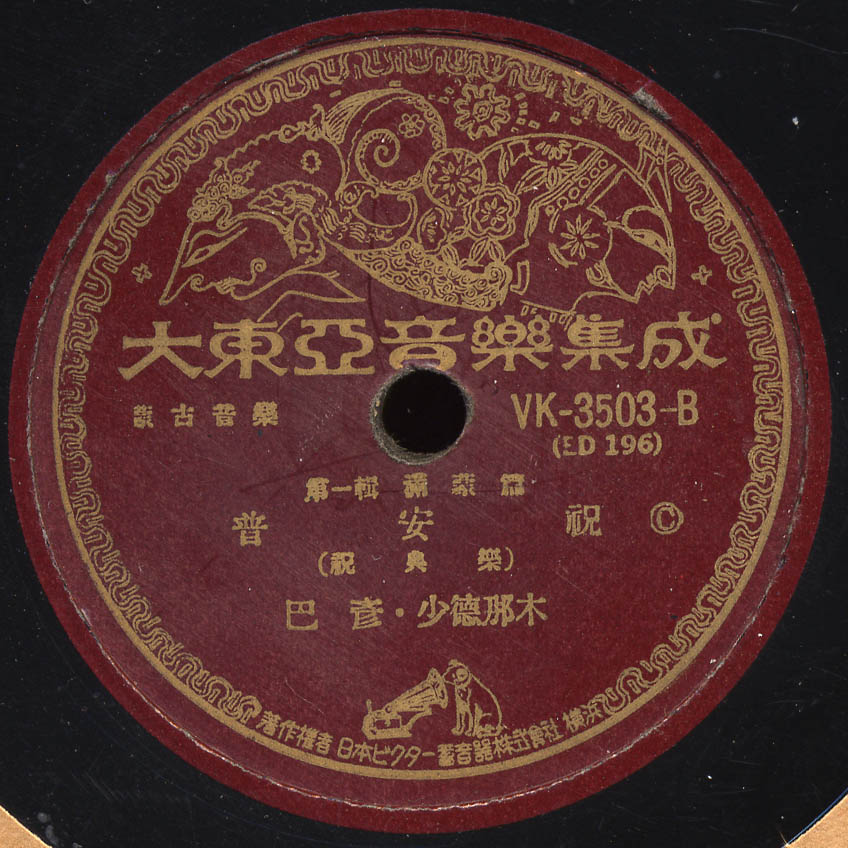
I picked up this record in a batch of 50+ Chinese and Japanese records. When I saw this strange label I knew I was onto something. My first guess was that it was Korean, even though the writing was in Japanese. Wrong! It turns out that this was part of a set called “The Ultimate Collection of Great East-Asian Empire’s Music” and was put out by Victor Japan, most likely in the late 1930s. It seems to have been something of a propaganda piece as Japan was trying to promote the idea that all the areas under it’s control (Inner Mongolia, Manchuria, Taiwan, Korea, and others) were part of one great “East Asian” Empire. If anyone has further information on this set, please contact me!
The B side lists the song name as “Mongolian Royal Festival Music” performed by Fa-Un and Shao-Tao-Nah-Mu (approximate pronunciation) and features the Mongolian hammered dulcimer called yoochin (or yoochun), a version of the Chinese yangqin and what sound likes a kuuchir (aka sihu), essentially a 4 stringed erhu.
The A side is available on the amazing Secret Museum of Mankind: Central Asia listed as Mon-Gu Tuul 1, my source transaltes it as The Song of Genghis Khan’s Horse.
(extra special thanks to youtube user transformingArt for help with this post!)
 HAJI MAJI
