
Hello again.
Let’s see….now where was I?
Malaysia! sure…why not?
Malaysia has a wild diversity of music captured on 78 rpm record and a wide range of influences; Malay, Arabic, Hindu, Indonesian, Chinese, Portuguese and more. Lagu Melayu (Malay songs) tend to fall into categories like the Hindu influenced Orkes Harmonium, the Islamic based Orkes Gambus (Gambus is an instrument derived from the oud) and Orkes Melayu (Malay songs with western instruments). Indonesian influenced styles like krontjong, bangsawan and stomboel were also popular. Ultimately these diverse styles gave way to the ubiquitous rock based Dangdut.
Today, after a long break, we present a venerable Malay genre with roots reaching back to the 15th century called Dondang Sayang, literally “to sing with love.” The band is always led by a violinist who weaves in and out of the vocal melody, backed by a rhythm section of rebana (frame drum) and tetawak (gong), accordion was later added to the core ensemble. The singer improvises a kind of classical Malay poetry called pantun, often bantering with a singer of the opposite sex.
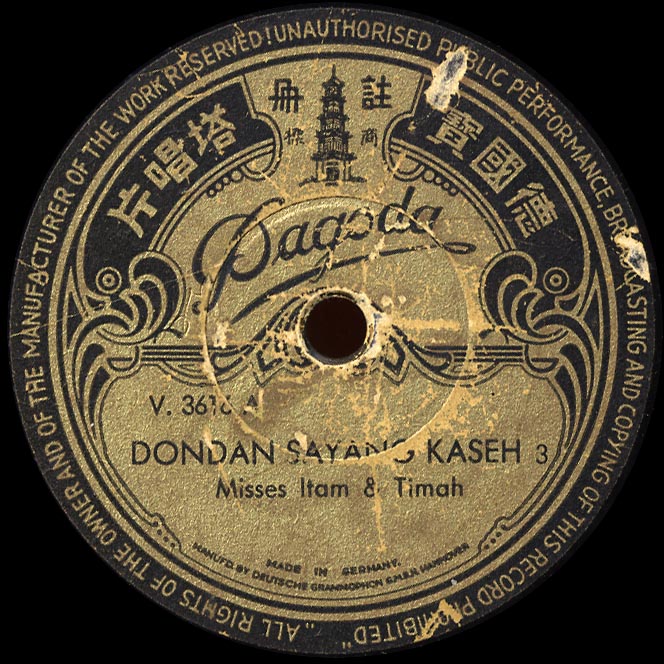
Here’s a scratchy, but excellent example of Dondang Sayang sung by Misses Itam & Timah for Singapore’s Pagoda label in 1930. I think each singer does one side of this record, but I have no clue which is which.


Filed under: Burma
The modern songs are quite varied, incorporating western musical elements and instruments to different degrees, sometimes shifting between western and Burmese styles within one song. I have examples of songs recorded in a western idiom on one side and continued in a Burmese idiom on the flipside.
Here’s one which is relatively traditional in instrumentation, with hne (oboe), pa’ wain (tuned drum circle), si’ wain (gong circle), patala (xylophone).
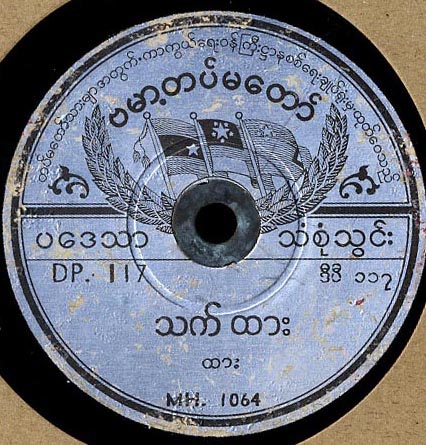
Here’s Thet Htar by the singing Htar, a love song dedicated to soldiers on the Padaytha label of the 1940s.
Thanks again to Su Wai for translation!
Filed under: Burma
Here’s a good example of a Burmese “modern song” that shifts back and forth between Burmese and Western instrumentation and style. This record features the well known singer Pyi Hla Pe who was also a member of the Ministry of Culture. The Ministry of Culture was formed in 1952 to promote traditional culture and recently made the unfortunate ruling that Western instruments cannot be in traditional hsain waing ensembles.
Although this song doesn’t feature a hsain waing orchestra (a classical ensemble with gong circle and xylophones), it does include Western instruments such as piano, Hawaiian guitar and violin.
Like many of the mid-century Burmese modern songs, this is a love song called Papa Win, meaning “A Very Special Beauty.”
Since this is a two part song, I’ve included both sides of the record in one mp3 file.

Thanks to the excellent Burmese pianist Sandaya Aung Win (Phillip Aung-Win) for help with this post.
Filed under: Burma
Daw Khin Hla Dat-Pyar (“Dat-Pyar” means Records)…thanks to Rob Millis for finding that info!
Filed under: Burma
By the 1930s, the imported Western piano had gained popularity among Burmese musicians. It was used in the new “modern music”, a Western-Burmese fusion, as well as being played in Mahagita chamber ensembles along side the saung-gauk (harp) and violin or used as the solo accompanist to a singer. It was even used to accompany silent films.
In the classical context, musicians transfered the playing techniques from the patala (xylophone) and pat waing (the tuned drum circle) to the piano. Pianists often play improvisations based on Mahagita pieces, with fast, virtuosic and highly ornamented runs based on the saung-gauk style developed in the 1930s.
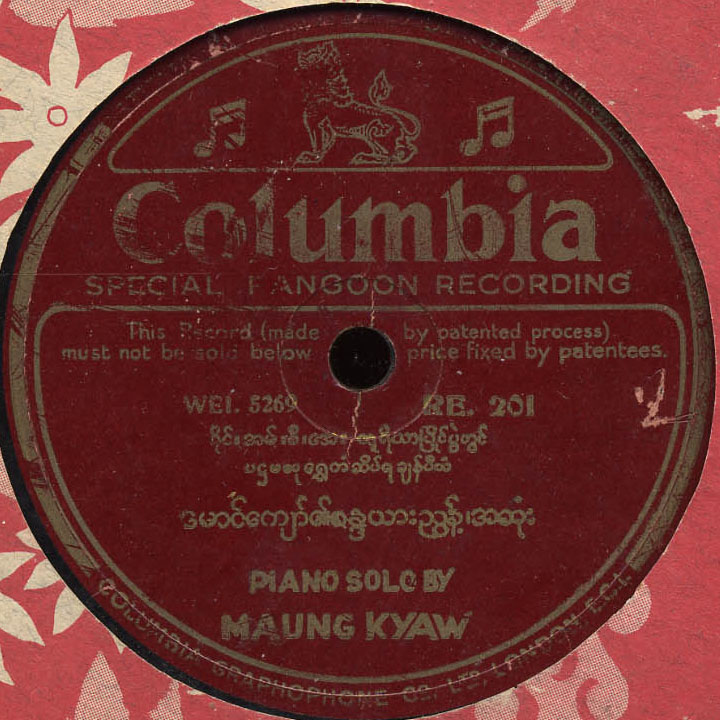
Here’s an improvisation by university student simply titled “Best Piano Solo.”
Filed under: Burma
Mahagita (Sanskrit for “Great Songs”) is the term used to describe the Burmese classical repertoire. Some Mahagita songs are hundreds of years old and written down only as song-poems, there’s no music notation in the Burmese classical tradition.
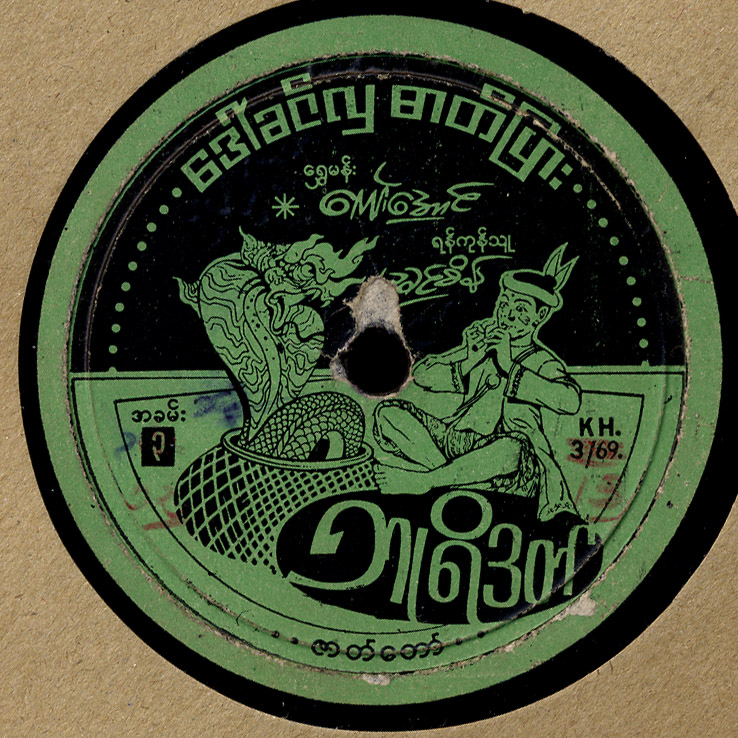
This beautiful record is by the venerable singer Mar Mar Aye, who currently lives in the United States at age 67 and is unable to return to Burma for political reasons.
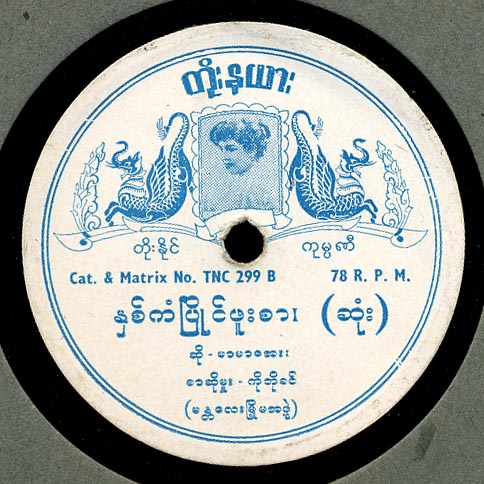
Mar Mar Aye is known for her long and elaborate medley’s that are quite complex and difficult to perform. Here she sings the second half of Hnit Kan Pyaing Pou Zar (“Young Lovers United by Destiny,” approximately), composed by Ko Bo Khin and backed by the Myo Ma band. The band consists of piano, pat waing (tuned drum circle), violin and percussion.
As in most of Southeast Asia, there was quite a proliferation of independent labels in Burma in the 1940s and 1950s after years of domination by the Gramophone Company and HMV. Considering that Mar Mar Aye was born in 1942 this record must date from the late 1950s or early 1960s. This is one of the few records I’ve come across on the Toe Naing (Dragon) label.
Filed under: Burma
It’s been about a year since we left Chinese music behind and began a musical tour of the rest of Asia. It’s been slow going as we made our way from Japan down to Vietnam, Cambodia and then Thailand. There’s plenty more good stuff from Thailand, but I think it’s time to move on. We skipped Korea and Laos, but I hope to hit those on the way back.
I’m a huge, huge fan of Burmese music (not to mention Burmese food!) and I’m lucky enough to live near a fellow named Rick Heizman. Rick is a great musician from San Francisco who has a real passion for Burma, it’s music, culture and people. For years he’s been traveling to Burma and documenting the music, releasing some of it on his own Earthview label as well as Shanachie and Folkways. Rick and his wife Su Wai (a well known Burmese harp player) have been kind enough to help me out with translations and other musical information on the next few posts.
The first Burmese recordings were made by the Gramophone Company’s Fred Gaisberg on his incredible 1902 Asian recording expedition. Starting in Calcutta, he managed to make hundred’s of recordings in Tokyo, Shanghai, Hong Kong, Singapore, Bangkok and Rangoon. Recordings were made in Rangoon on GC’s second expedition in 1904 by William Sinkler Darby and again in 1905-06 by Fred’s younger brother Will. Of course, the Gramophone Company wasn’t the only label recording in Burma. The German label Beka recorded in Rangoon as early as 1905.
Burmese 78s tend to come in one of three basic varieties; chamber music (music for indoors), drama and “modern music.” Our first record is of the chamber music variety, on the HMV label, and features the wonderful singing of Yadana Myit, backed by a saung-gauk (harp) and violin.
The suang-gauk is an ancient harp, some of the earliest depictions of it date from the 7th century AD and it was most likely brought from India as a court instrument. There are depictions of harps in other Southeast Asian cultures as well, such as at Angkor, but the instrument has not survived in those cultures. The boat shaped resonator is constructed of wood and covered with deer skin. The modern saung-gauk has sixteen strings and uses four basic classical tunings, all of which are pentatonic.
The harp is often played by women and is used to accompany singing for indoor chamber music, as opposed to the drum and gong based outdoor ensembles. Sometimes the harp is paired with a guitar, piano, xylophone or violin.
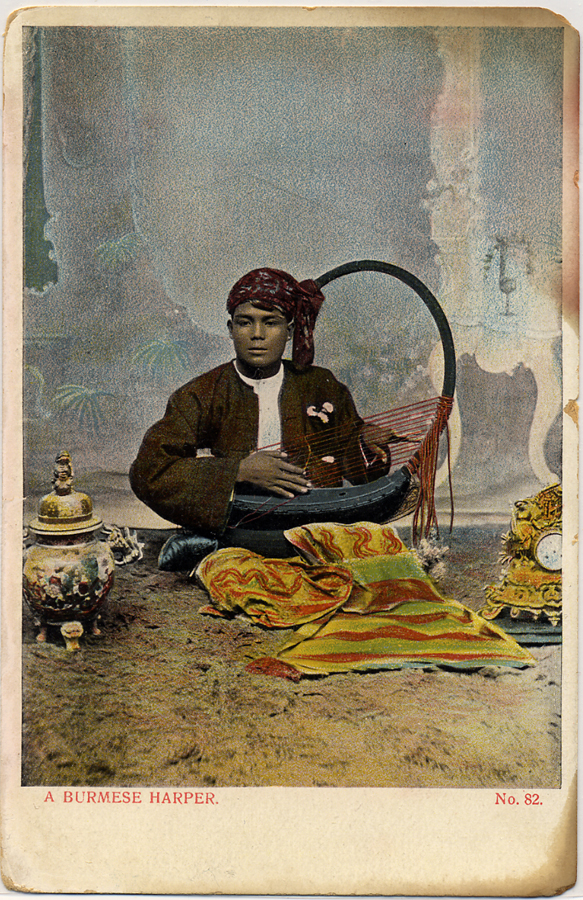
This record was recorded in 1928 or 1929. The title is Sone Nant Tha Myaing or “The Fragrant Forest.”

Thanks to Jonathan Ward of Excavated Shellac for some audio work on this post. It’s still plenty scratchy, but he pulled it back from the brink of pure noise!
Filed under: Thailand
Here’s the last post of the year, you might want to throw this one one at your New Year’s Eve party…see you in 2010!
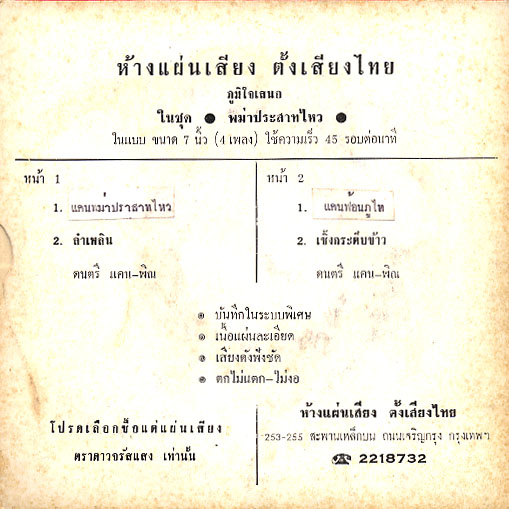
In the 1960s, Molam began to modernize, adding drums and other instruments, perhaps in an effort to compete with the wildly popular luk thung performers. Here’s a fantastic instrumental 45 rpm record with some nice khaen playing and a prominent phin, a small 3 string lute.

Filed under: Thailand
Here’s another old style khaen piece, but this time with the molams (singers) Bunpheng Phaiphiwchai and Wichian. There are many different regional types of lam (songs) in northeast Thailand (Isan) and Laos, some based on traditional, poetry, Jataka stories (Buddha birth stories from India) and courtship songs. Courtship songs often include racy repartee between male and female singers.
Here’s another great 45 rpm 7 inch record.


 HAJI MAJI