

Pagoda was a great label that was most likely a subsidiary Deutsche-Grammophon along with Polyphon and Hindenburg. Pagoda seems to consist mostly of Teochew Opera from southern China. Unfortunately, I broke the Pagoda record I wanted to post while trying to get it’s too small spindle hole to fit on the turntable…so this is the runner up!
Performed by the Old Choy Bo Fung troupe. (thanks to Patrick Lau for translation.)
Filed under: cantonese opera | Tags: Bai Ju Rong, cantonese opera, Oriental
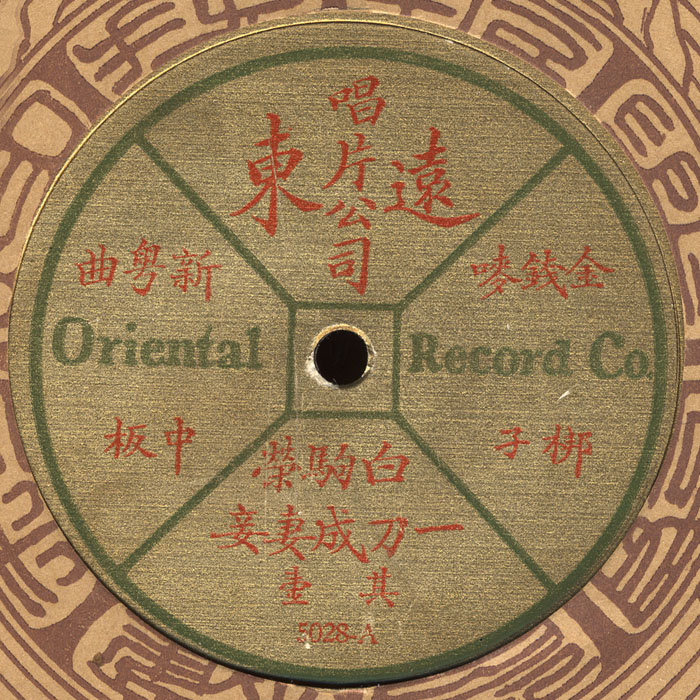


I had a request for some more Bai Ju Rong, the amazing Cantonese singer featured below on the Clipper label. Here he is on the obscure Oriental Records label.
JW over at Excavated Shellac has posted a great Cantonese Opera recording this week, so I decided to post some Chinese music that isn’t opera. Here are two records of instrumental music.What would Confucius play? The Guqin, a 7 string zither, is a very old instrument that was associated with philosphers and scholars, and played by Confucius 2500 years ago! The music is very different from the Chinese Opera we’ve been listening to, which is essentially folk music, while the Guqin played meditative art music. This was probably the first instrument to use tablature notation, some of it was written as early as the 12th century. Pretty amazing. A nice cd of old guqin recordings by Lo Ka Ping is available here.

The Sanxian is basically a banjo. It has 3 strings, usually tuned DAD, and a fretless neck. The lack of frets allows for all kinds of great slides and unusual intonation. It’s body is covered with a python skin. Sanxian is used throughout China and there are variations all over South East Asia.


Blind Musicians from Shanghai. Sanxian player in the middle.
Filed under: Amoy Opera
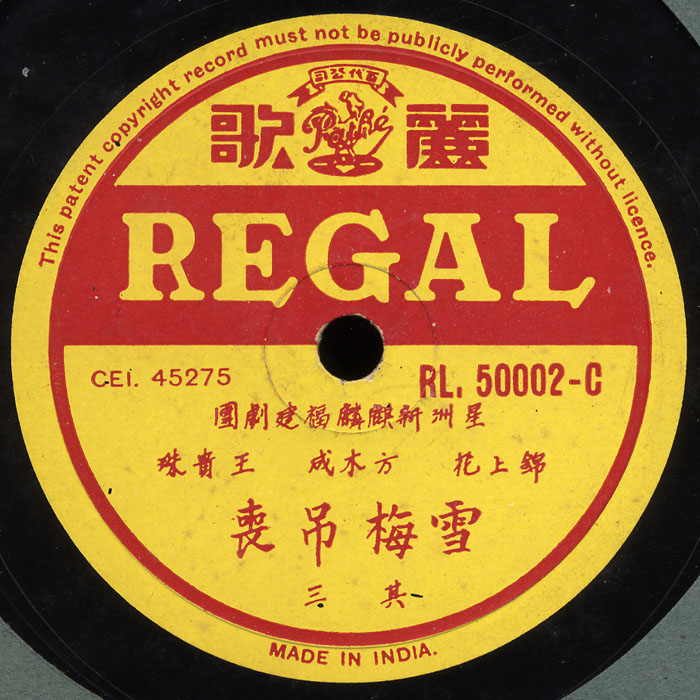
Here’s an interesting one on Regal. Chinese opera was usually released in the form of a 2, 3 or 4 record series to accommodate the lengthy lyrics. The music tends to be very similar on each side of these series, often with subtle variations or key shifts. Such is the case with this 2 record series, of which this is the third part. The first three sides are almost musically identical except part 3 introduces some amazing sliding and tremolo. Not only is this effect not on the other songs in this series, I’ve never heard it on any other Chinese record!
I’m not too sure about the history of Regal, but it’s obviously a subsidiary of Pathe at the time of this release.
Filed under: Instrumental


I’m sure, Gentle Reader, that you’ve now realized my method of surveying Chinese Opera is based on a tour of the different record companies in addition to the different styles. Columbia records was perhaps the most prolific label recording in China, starting just after the turn of the century through the end of the 78 era. Cantonese, Peiping, Teochew and other types of opera were all recorded by Columbia and many of the later records from the late 30’s and 40’s have a much more “westernized” sound than the music posted on this blog. These more modern sounding records are some of my least favorite so I always approach Columbia records with caution!
Traditional Chinese Operas often included instrumental sections, either to entertain between acts or fill time during costumes changes, etc. Instrumentals were rarely recorded, presumably because the opera genre is far more oriented toward the vocalists and the music almost seems to be secondary. Nonetheless, there is a vibrant offshoot of opera music known as “Silk and Bamboo” (Silk referring to strings and Bamboo to woodwinds). This music is usually instrumental and is played in public by amateurs in an informal setting such as a tea house, not unlike Irish pub music sessions. There is still a lively Silk and Bamboo scene today in Shanghai.
This rousing tune is played on the gaohu (similar to erhu), yehu (two string instrument with coconut sound-box, sounds like viola), qin qing (banjo-like instrument.)
(UPDATE: It just occurred to me that this is the well known tune “Rain Dropping on Banana Tree”…I hadn’t noticed because it’s so much faster than the older version I’m familiar with…the older version can be heard on the Rounder cd of the same name.)

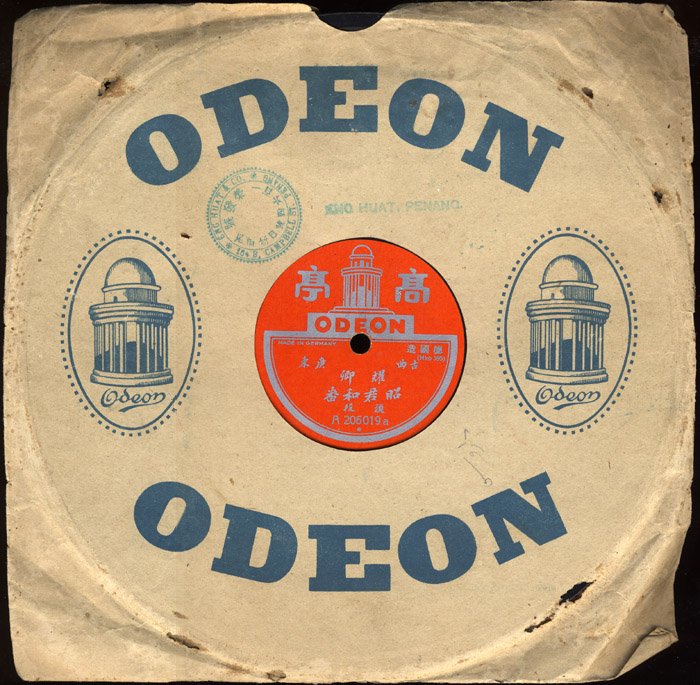
Here’s an excellent recording on the Odeon label featuring the Yangqin, a Chinese hammered dulcimer. The hammered dulcimer is used all over the world; Santur in India, Santoor in Perisa, Santouri in Turkey and Greece and various forms of the Cymbalom used throughout Eastern Europe. The Yangqin is a common instrument in Cantonese “Silk and Bamboo”, a form of folk playing that is closely related to Chinese Opera. I think this may be the only record I have that features the instrument.
The Odeon label included many different forms of Chinese Opera from all over the country. This one, I believe, was recorded in Hong Kong.
Filed under: cantonese opera | Tags: 78 rpm, 78rpm, Amoy Opera, Bai Jurong, beijing opera, cantonese opera, chinese opera blog, clipper, erhu, Ju Rong, Peking Opera, teochew


Bai Ju Rong, aka Bak Keui Wing (1892-1974) is one of my favorite singers. He was trained as a youth in the role of Xiaosheng, one of the subtypes of the main male role known as Sheng. Xiaosheng roles were handsome young men involved in various romantic intrigues and adventures. Bai Ju Rong went on to be thought of as the “Xiaosheng King” and made a major impact on Cantonese opera in the 1920’s. He re-defined almost every aspect of the performance; most importantly he switched from using the archaic “Official Cantonese (which many could not understand) to using vernacular language. He also changed the singing from an affected high voice to a natural, flowing “true voice” and made his mark on the use of gestures and melodic recitation.He started losing his sight and eventually had to quite performing. By 1948 he was reduced to singing in the street. Amazingly, he made a comeback and was again very successful. In 1958 he became principal of the Guangdong Opera School. This is part one of four.
Filed under: cantonese opera | Tags: 78 rpm, 78rpm, Amoy Opera, beijing opera, cantonese opera, chinese opera, erhu, gramophone, Peking Opera, teochew


Here’s a beautiful Cantonese recording. I love this old style which is sparse but with a great rhythmic groove. Many people think of Chinese Opera as being very arrhythmic, and it certainly can be, but this record and many others are played in the same way fiddle music is played all over the world, with a steady pulse.
According to the label, this is a Hua Dan role performed by Xiao Hong Xin. Dan is the name for female roles in China, Hua Dan being one of half a dozen common female roles. Hua Dan is a younger, coquettish female who usually accompanies a Gui Men Dan, a virtuous older Lady, exemplified by the superstar Mei Lan Fang. Often these roles were performed by men, but I believe that Xiao Hong Xin is a woman. (Thanks to David Du for translations).
Thanks to the erudite JW over at Excavated Shellac the mystery is cleared up…the label is actually called “Hindenburg” with a picture of General Paul von Hindenburg, President of Germany (1925-1934) as the trademark. My apologies to the General for mistaking him for Kaiser Wilhelm! Hindenburg, Pagoda and Polyphon were under the umbrella of Deutsche-Grammophon.
“Mech. Copt. 1927” is stamped in the shellac.
Info from Tan Sooi Beng’s article “The 78 RPM Record Industry in Malaya Prior to World War II” (Asian Music 28/1 (1996)).
Filed under: Amoy Opera | Tags: 78 rpm, 78rpm, Amoy Opera, beijing opera, cantonese opera, chinese opera, erhu, His Master's Voice, HMV, Peking Opera, teochew

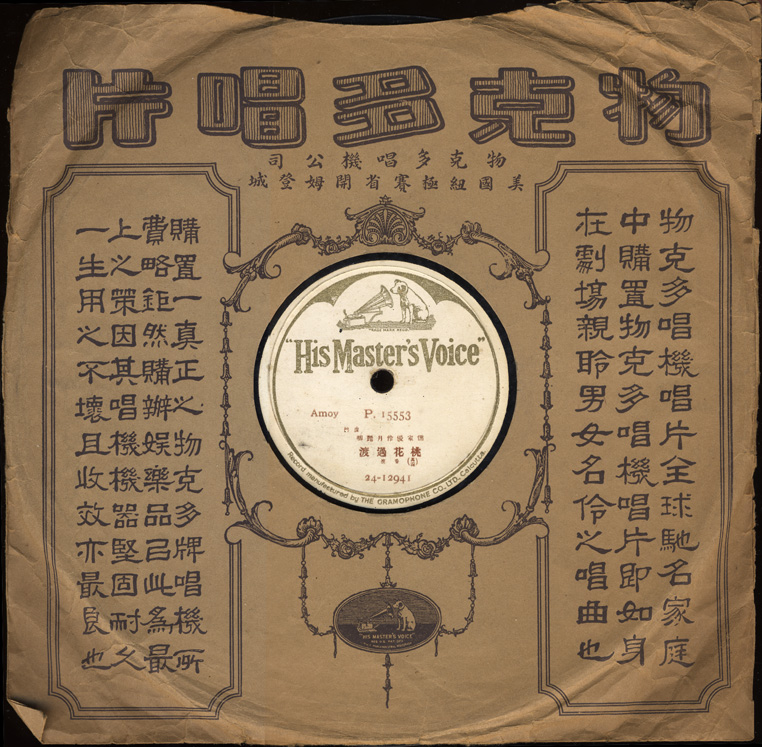
Welcome back, Dear Reader, for another dose of of exceedingly obscure Chinese Opera. This time we have an example of Amoy Opera on the His Master’s Voice label. Amoy (aka Hokkien) is a language/dialect from the Southern Chinese province of Fujian, which neighbors the Guangdong province, the origin of our last posting of Teochew Opera. Amoy is directly across the strait from Taiwan and the language and music are basically the same. Like the Teochew people, the Fujian people emigrated to many parts of Southeast Asia, taking their music and language with them. Forms of this opera style are still popular in the region today.
A bit noisy at first, but it clears up…Enjoy!
Filed under: Teochew Opera | Tags: 78 rpm, 78rpm, Amoy Opera, beijing opera, cantonese opera, Chinese music, chinese opera, erhu, Peking Opera, Southeast Asian music, teochew


Here’s a beautiful and hypnotic Teochew Opera on the obscure Tiger label. Teochew is a Chinese dialect from the Guangdong region of Southern China. The Teochew music bears more resemblance to Southeast Asian music than other Chinese opera forms, especially the Peking opera (in fact, this was recorded in Thailand according to one of our readers, see comments for further info). This record is a great example of the measured rhythm and clear melody of the Teochew style, with little of the wild percussive effects of the Peking style. During the 18th-20th centuries there was much emigration from Guangdong into Thailand, Malaysia, Singapore and elsewhere in the region and a healthy Teochew Opera scene existed in those places until recently.
 HAJI MAJI